What is photovoltaic self-consumption?
Self-consumption means generating your own clean energy using photovoltaic panels installed at homes, businesses, municipal buildings, or even at an industrial scale.
Through a renewable energy installation, particularly solar photovoltaic, wind, biomass, or small hydro, consumers can generate and use their own electricity.
Royal Decree 244/2019 of April 5, which regulates the administrative, technical, and economic conditions of electricity self-consumption, is the current legislation governing self-consumption.
However, in October 2024, a prior public consultation was published regarding a draft Royal Decree regulating the administrative, technical, and economic conditions of electricity self-consumption, with the aim of updating the existing legislation. The process is scheduled to continue in October 2025 with the publication of the first draft of the new text for public review and consultation, which will modify certain aspects related to electricity self-consumption and promote distributed energy storage.
The Institute for Energy Diversification and Saving (IDAE) has produced several documents to promote the development of self-consumption and to simplify the process of installing a self-consumption system. The guides are as follows:
Professional Guide to Self-Consumption Processing
Collective Self-Consumption Guide
UNEF approaches self-consumption from all perspectives, collaborating with various sector stakeholders and our members in different working groups.
UNEF estimates the installed capacity in Spain on a quarterly and annual basis. The most up-to-date data include:
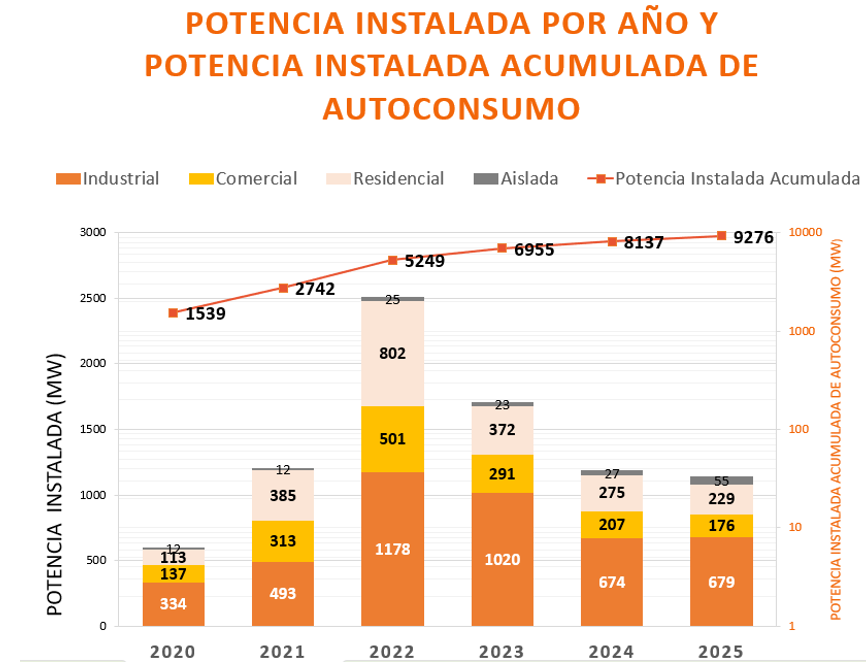
Installed and cumulative capacity (logarithmic scale) of self-consumption per year (source: UNEF own elaboration).
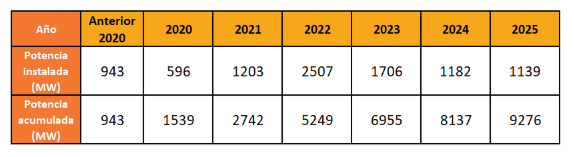
Installed capacity of self-consumption per year (source: UNEF own elaboration).
Considering installation types:
We propose measures affecting self-consumption regulation to promote greater deployment in Spain and reach the 19 GW of installed self-consumption capacity included in the PNIEC.
The following document details the 10 main proposals defended by UNEF, which have also been included in the prior public consultation mentioned above:
Self-Consumption Decalogue 2025
Additionally, you can download our detailed proposals here: UNEF Proposals for Self-Consumption Regulation 2025
Over the past year, UNEF has held sessions with Spain’s main distributors regarding self-consumption processing, explaining the procedure through each of their platforms.
A dedicated account is also available for members to report problems or obstacles encountered during the self-consumption installation process.
Another UNEF priority is ensuring the quality and safety of self-consumption installations. To achieve this, small working groups are creating materials and initiatives in collaboration with the National Institute for Safety and Health (INSST).
One of the documents produced is the Good Practice Guide for Fire Safety in Rooftop Photovoltaic Self-Consumption Installations.
We also offer the Quality Seal for self-consumption installation companies that are committed to professional training and high-quality installations.
*Small working groups consist of a limited number of UNEF members actively working on a specific topic.
Self-Consumption Alliance
UNEF is a member of the Self-Consumption Alliance, a platform established in April 2017, composed of social, ecological, business, union, and consumer organizations. The Alliance promotes self-consumption and carries out initiatives supporting this clean form of energy consumption.
Alliance for Safety and Sustainability in Building (S2E)
UNEF is also part of the S2E Alliance, a platform that brings together various industries in the construction sector to promote responsible and effective practices for rooftop installations, among other initiatives, fostering training and knowledge transfer.
Monthly Self-Consumption and Energy Communities Bulletin
Every month, UNEF sends members the Monthly Self-Consumption and Energy Communities Bulletin, which includes available subsidies and support for self-consumption and energy communities, as well as useful information for legalizing self-consumption installations. This includes updates on exemption procedures, building permits in different Autonomous Communities, links to different administrative self-consumption registers, and installed capacity data to date.
Webinars
UNEF provides members with opportunities to learn about topics of interest through webinars.
This year, sessions covered topics such as tax deductions for energy efficiency improvements and balcony solar systems.
Self-Consumption Summit
UNEF hosts an annual Self-Consumption Summit, a space dedicated to current topics. The summit gathers representatives from different institutions and industry experts.