Agrivoltaics is a dual-use production system in which the primary activity is agriculture, and which synergistically integrates primary sector activities with electricity generation through photovoltaic technology within the same physical space.
General characteristics of an agrivoltaic project:
Maintaining agreements between landowners, producers, and farmers or livestock operators.
Sustaining a viable agricultural and energy business case.
Integrating environmental sustainability criteria and efficient land use
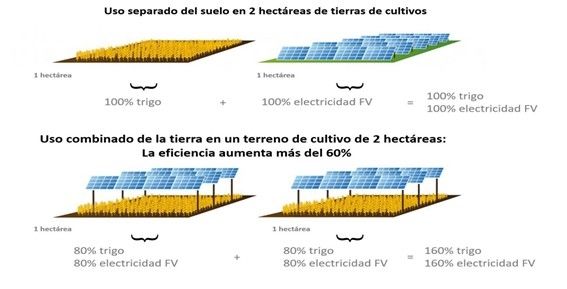
Agrivoltaics may involve dual land use by combining renewable energy production through photovoltaic systems with agriculture or livestock farming, provided there is a synergistic use of the shade generated by the photovoltaic panels.
To assess the performance of an agrivoltaic plant, total land productivity must be analyzed rather than evaluating the output of each activity separately. For this purpose, the Land Equivalent Ratio (LER) is used. This metric compares the efficiency of dual land use (simultaneous agricultural production and electricity generation) against the separate use of land for each activity individually.

Agrivoltaics offers a range of agricultural, environmental, and social benefits, which can be summarized as follows:
A. Environmental
B. Agricultural compatibility
When design and management ensure the genuine continuity of farming activity, agrivoltaics does not imply productive abandonment, but rather compatibility. This dual activity enables:
C. Social
Electricity generation associated with agricultural operations introduces an additional source of income that can:
At present, most agrivoltaic projects in Spain are pilot initiatives, generally small-scale and often of limited duration. This makes it difficult to determine precisely how many remain operational or the total installed capacity nationwide.
However, there are estimates of the technology’s potential at the European level:
Potential in GWp (scenario assuming 1% of national territory used for agrivoltaics) by EU country
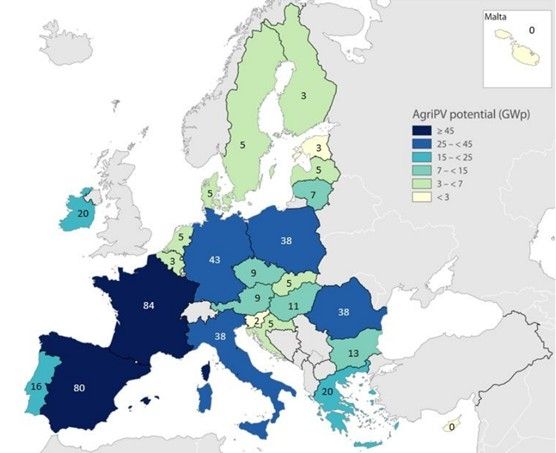
Source: Becquerel Institute
While several European countries already have specific definitions and regulatory frameworks promoting agrivoltaics, Spain currently lacks dedicated regulation in this field.
Compatibility with CAP (Common Agricultural Policy) subsidies is already a reality in many European countries, not only for agricultural projects but also for livestock operations. Spain is currently working on a definition based on CAP support for such installations. The main challenge is ensuring that the deployment of photovoltaic structures does not automatically result in the loss of agricultural eligibility when productive activity effectively continues.
At UNEF, we promote the synergistic integration of photovoltaic energy and the primary sector. We support the development of agrivoltaics, both in agricultural and livestock projects, acting as a strategic bridge between the photovoltaic sector, national institutions, and regional governments.
Our work goes beyond institutional representation: we connect knowledge, technology, and territory to define a shared model of success.
Our key activities:
UNEF’s work goes beyond sharing experiences; our commitment is to lead consensus-building so that agrivoltaics becomes a driver of a fair and productive transition in rural areas.