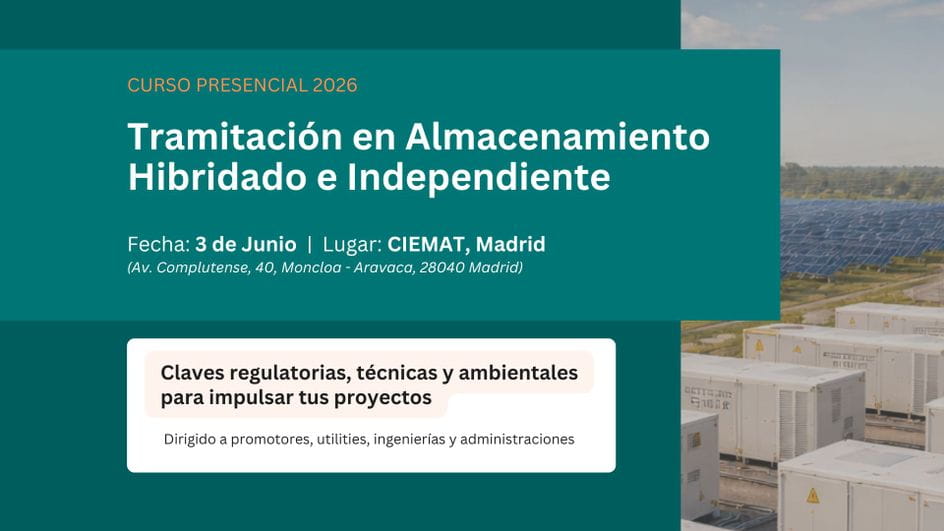
On June 3, the Course on Promoting Hybrid and Stand-Alone Energy Storage will take place. This in-person workshop is designed to provide a practical analysis of how to develop battery energy storage projects in the current context.
At a pivotal moment for the deployment of energy storage, this training offers a comprehensive overview of the main technical, regulatory, and administrative challenges that shape the development of BESS projects, as well as the opportunities presented by the new energy framework.
This is an intensive, hands-on training program designed to provide professionals in the energy sector with a comprehensive overview of the development of energy storage projects, both hybrid and standalone.
Throughout the course, the main phases of developing a BESS project will be addressed, from obtaining and updating access and connection permits to adapting to new regulatory frameworks, the technical design of the facility, environmental permitting, and the requirements necessary for commissioning.
The program is designed to address real-world challenges in the sector and provide useful criteria for decision-making in ongoing projects. It is aimed at developers, utilities, investors, manufacturers, and consulting firms involved in the development, permitting, design, or execution of battery energy storage projects.
Program
Session 1. 10:00 a.m. – 10:20 a.m. How are access and connection permits for storage facilities obtained and updated?
How is the access and connection permit updated for hybrid facilities? How can access and connection permits be obtained for hybrid facilities?
Coffee Break. 10:20 – 11:00
Session 2. 11:00 – 11:40 Flexible access to storage. Project processing at the national level
How does storage access change with the new flexible permits? What happens to permits already granted for storage?
Session 3. 11:40 a.m. – 12:40 p.m. How do I size and design my storage system? How should I size my MW/MWh batteries in relation to photovoltaic capacity and the grid connection permit? Can I integrate a hybrid system using direct current? What about alternating current at low voltage?
Block 4. 12:40 – 13:20: What is the environmental permitting process for my battery?
How does the environmental permitting process for electrochemical storage differ from that for non-electrochemical storage? What differences in environmental permitting might exist between a hybrid storage system and a ‘stand-alone’ storage system?
Session 5. 1:20 PM – 2:00 PM How can a battery be brought online quickly?
What tests must be passed before the system enters commercial operation? Are there any specific requirements or considerations for storage that should be taken into account compared to other grid-connected assets?
PRICES
GENERAL €225 + VAT
MEMBERS €150 + VAT
4x3 PROMOTION Available for this course.