
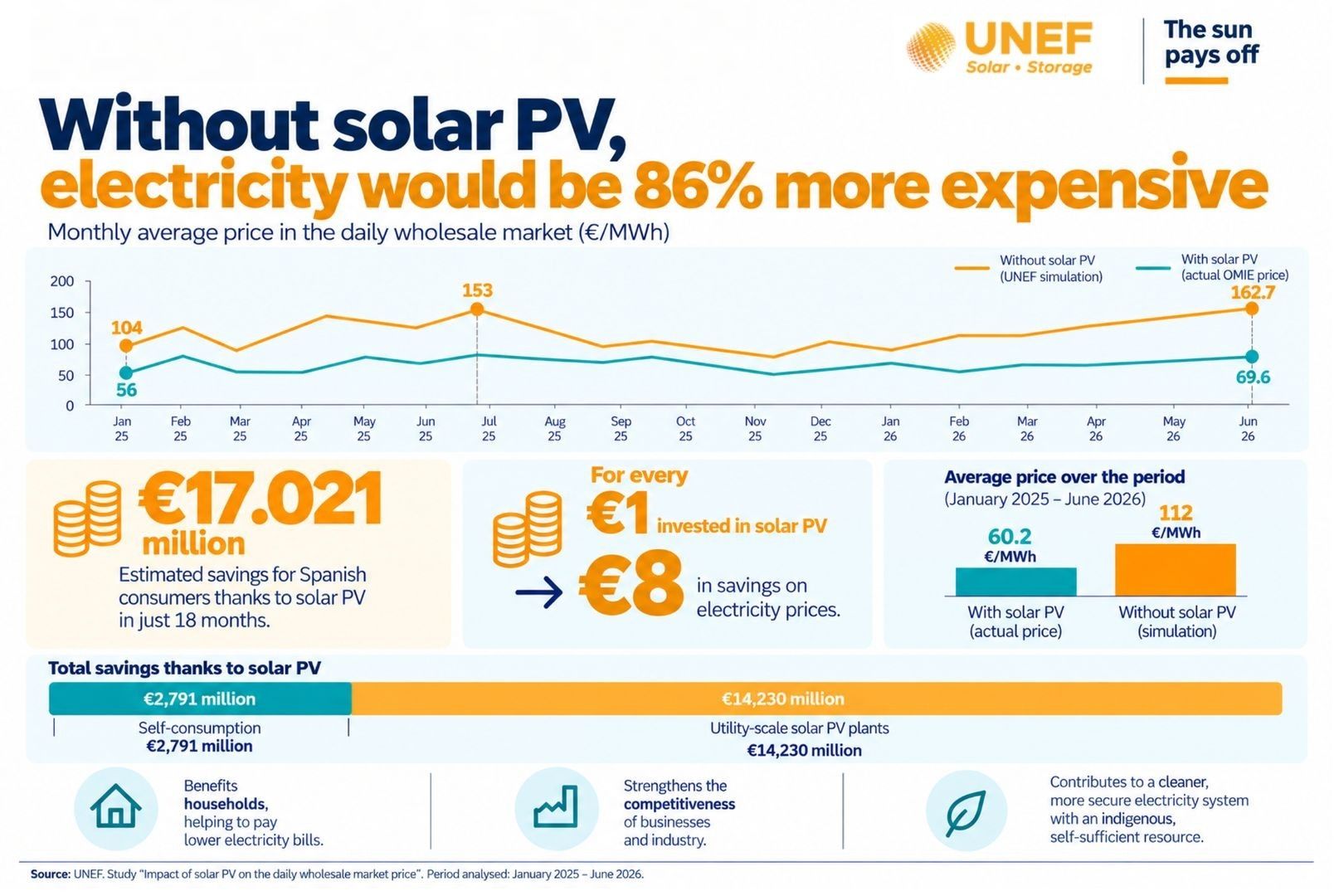
- A UNEF study shows that, without solar PV, wholesale electricity prices would have been 86% higher.
- For every euro Spanish society invests in solar PV, it saves eight euros in electricity costs.
- Self-consumption also reduces electricity prices for everyone, including those without solar panels. Solar self-consumption has generated an estimated €2.791 billion in savings for Spanish electricity consumers as a whole.
Madrid, 21 October 2026. Solar photovoltaic energy has saved Spanish electricity consumers €17.021 billion in just 18 months, between January 2025 and June 2026, thanks to its ability to reduce wholesale electricity prices. This is the main finding of a new study by the Spanish Photovoltaic Union (UNEF), which quantifies the economic benefits of solar PV for Spanish society as a whole.
The analysis shows that electricity would have been considerably more expensive without solar PV generation. During the period analysed, the average day-ahead market price was €60.2/MWh, compared with the €112/MWh it would have reached without solar power. This represents a 46% reduction in electricity prices or, put another way, electricity would have been 86% more expensive without solar PV.
This effect benefits all electricity consumers, including households, businesses and industry, by reducing wholesale electricity costs.
The findings highlight the economic value of investing in solar energy: for every euro Spanish society invests in solar PV, it saves eight euros in electricity costs, according to the relationship between investment and savings associated with the presence of this technology in Spain’s electricity mix.
Solar self-consumption also reduces electricity prices for everyone
One of the study’s main conclusions is that the economic benefits of solar PV do not come exclusively from utility-scale solar farms. Solar self-consumption by households and businesses also helps reduce electricity costs for all Spanish consumers.
According to UNEF’s analysis, of the €17.021 billion in estimated savings over the 18-month period, €2.791 billion can be attributed to solar self-consumption, while the remaining €14.230 billion comes from utility-scale solar PV generation.
When a household or business generates and consumes its own electricity, it reduces the amount of energy it needs to purchase from the grid. This lower demand helps keep wholesale electricity prices down, generating benefits that extend beyond the individual savings enjoyed by those with self-consumption installations.
As a result, solar self-consumption not only reduces electricity bills for those who install solar panels but also helps lower electricity costs for other households, businesses and industries.
Savings continue to grow in 2026
The study estimates that solar PV generated €10.863 billion in savings during 2025, followed by a further €6.158 billion in the first half of 2026.
The difference between actual electricity prices and the prices that would have been recorded without solar PV remained significant throughout every month analysed.
In June 2026, for example, the average day-ahead market price was €69.6/MWh, whereas without solar farms and self-consumption it would have reached €162.7/MWh.
These findings confirm that the deployment of solar PV is a fundamental tool for containing electricity costs and improving the competitiveness of the Spanish economy.
“Solar PV is much more than an electricity generation technology: it is a strategic investment in Spain’s energy security and competitiveness. We have the enormous advantage of having access to an abundant, free and domestic resource — the sun — which allows us to generate electricity without relying on imported fossil fuels and to reduce our exposure to volatility in international markets,” said José Donoso, Director General of UNEF.
“Furthermore, solar self-consumption is set to play a fundamental role in the reindustrialisation of our country. It enables businesses to access more competitive electricity, reduce their energy costs and gain greater energy independence, creating better conditions to attract investment, develop new industrial activities and generate employment. Investing in solar PV means investing in a more competitive, more industrialised Spain with greater security of supply,” he added.
About the study:
- The study calculates what day-ahead electricity market prices would have been without solar PV between January 2025 and June 2026, using data from OMIE, Red Eléctrica and UNEF. To do so, UNEF replicates OMIE’s market-clearing process, excluding electricity generated by utility-scale solar farms and self-consumption installations in households and businesses, while accounting for the response of other technologies participating in the market to the resulting prices. The difference between the actual cost of electricity purchased in the day-ahead market and the cost that would have resulted without solar PV generation represents the savings delivered by this technology to Spanish electricity consumers.
- The analysis focuses on the day-ahead electricity market and does not include technical constraints, balancing services or forward contracts, which also contribute to final electricity prices. The savings reflected in individual electricity bills will depend on each consumer’s tariff and electricity supplier. The modelled response of combined-cycle gas plants and hydropower facilities is based on their actual market bids, although changes of this magnitude could lead to different bidding strategies.
Full report: “The Impact of Solar PV on Day-Ahead Electricity Market Prices”